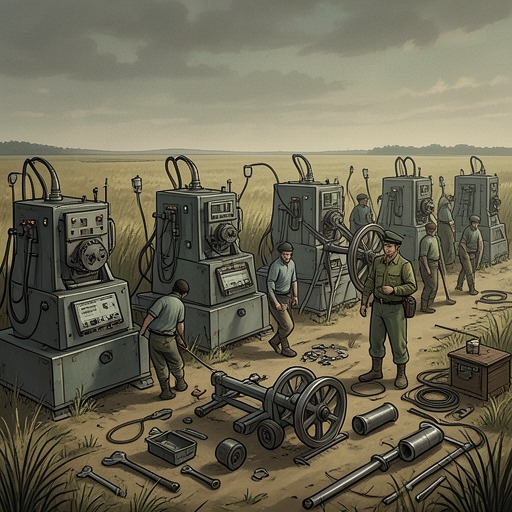
Father’s Two-Stroke Engine
The Greatest Beer Run Ever: A Memoir of Friendship, Loyalty, and WarFather’s Two-Stroke Engine was at once a practical device and the center of Francis (Frank) McGahern’s sustained fascination with machinery. It brought electric light to the barracks and charged batteries for the radio, but its recurring failures exposed the frustration surrounding its use and turned one repair journey into a lasting rupture between father and son.
Workshop and Purpose
The engine replaced a windmill Francis had erected beside a large sycamore tree after visiting the deaf parents in Aughavas. The windmill never supplied electricity to the barracks; after years of turning in changing winds, it was blown down in a storm. The engine was kept in a workshop across the small yard from the scullery door, where Francis spent hours among benches, tools, old car tyres and tubes, and an extraordinary collection of cheaply bought batteries. Some of the batteries were large, made of glass, and beautiful to look at; tall glass jars held acid and distilled water.
Francis strung up a small lighting system powered by the engine. When the engine ran and its light bulbs flickered, he was excited and happy. The children felt relief and pride when the lights worked, though they preferred the calm of the oil lamps. The lighting plant also charged the wet batteries for the radio, sparing the family trips to Stewart’s in Boyle to have them charged.
Repeated Failure and Repair
The engine never worked for long. Francis repeatedly took it apart and reassembled it, until frustration forced him to gather its small components into an apron and take the engine to a garage. On one such trip, the narrator helped collect the parts into a brown apron before accompanying his father by car toward Pat’s garage in Ballinamore.
Less than a mile out of Cootehall, Francis stopped the car to check the parts again. When they opened the apron, he found that a small but essential component was missing. He accused the narrator of losing it and beat him on the roadside, although the narrator knew nothing about the part. Francis turned the car back toward the barracks. The part was on the workshop bench, where Francis himself had left it.
Conflict and Consequence
Finding the part where Francis had left it proved the accusation unjust. For the narrator, that proof gave him steel: he refused to continue to Ballinamore and wanted nothing to do with his father for weeks, despite Francis’s attempts to win him over. The repair errand thus ended not at the garage but in a confrontation whose consequence outlasted the engine’s immediate failure.
The engine’s importance lies in this contrast. It could briefly produce light and practical relief, and its working state brought shared pride; yet it repeatedly slipped beyond Francis’s mastery, despite his intense interest in it. The memoir leaves that inability puzzling, noting that the small engines were not complicated. In the roadside episode, a missing component becomes more than a mechanical problem: the decisive fact is that it was left on the bench, and the narrator’s discovery of this unfairness changes his response to his father.